

Did you know? According to CSA Research, 40% of users never buy from websites that are not in their language. If your marketing is only in English, you are missing out on almost half of the global market.
However, many brands still make the mistake of thinking that translation is the finish line. In reality, this is just the start. High-impact marketing requires a deep dive into local nuances and consumer habits. A true multilingual strategy adapts your brand’s DNA to fit the local context. That is what will really drive your sales.
In this article, we will go over all the main points that will help you establish and run an efficient multilingual marketing strategy, including:
- Definition of multilingual marketing and how it can impact ROI
- How to prioritize marketing content and channels
- Step-by-step multilingual marketing strategy implementation process
- Tech solutions for translation process management
Whether you are a small business or an enterprise looking for ways to improve conversion rates in new markets, you will get valuable insights. Keep reading.
What Is Multilingual Marketing?
Multilingual marketing is a marketing approach that involves adapting brands’ messaging, content, newsletters, SEO, and marketing campaigns to align with the cultural nuances of global audiences. To get a better understanding, you need to distinguish several key terms:
- Translation is the process of converting words into different languages.
- Localization is the adaptation of all content to fit the cultural nuances, language preferences, and contextual expectations of the target audience.
- Multilingual marketing is a business strategy that combines cultural understanding, content localization, visual adaptation, search engine optimization (SEO) localization, and technological solutions to build trustworthy relationships with global audiences.
Whether you are adding new languages to a website, updating images, adjusting product descriptions, or localizing your site’s design, the goal is to make the whole user experience smooth for new markets.
That all sounds promising, but do not forget what it is all about: revenue. Let’s jump into some statistics that are important for business.
Multilingual Marketing ROI: Why to Invest?
Investment in multilingual marketing offers numerous benefits. There are actual measurable outcomes, including higher customer conversions, lower acquisition costs, and improved customer satisfaction and loyalty.
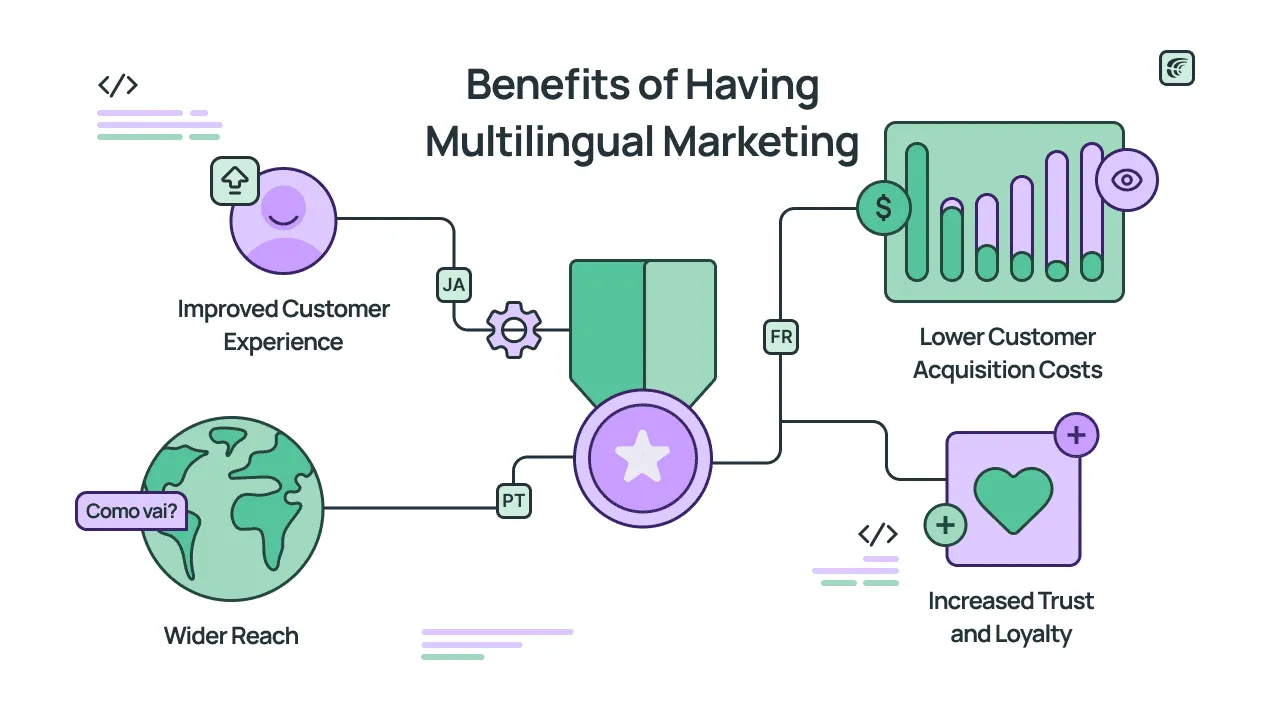
Improved Customer Experience
Providing information in English only is not enough. Continuous marketing research highlights how much language alone influences multilingual audiences’ purchasing decisions:
Research shows that 76% of consumers prefer to buy online from websites in their native language.
The purchase process should be as smooth as possible, that is why you need to localize your content. The goal is to ensure customers do not waste cognitive resources trying to figure out what things mean, so nothing disrupts them from buying.
Lower Customer Acquisition Costs (CAC)
Using the wrong strategy for acquiring an audience in the new market can lead to unsatisfactory results at high costs. Here are the benefits of multilingual marketing:
- Localized SEO generates organic customer traffic by implementing locally adapted keywords, thereby reducing the cost of paid ads.
- Multilingual websites, emails, and social media ad campaigns improve click-through rates (CTR) by aligning with cultural idioms and search intents.
In practice, companies can generate higher-quality leads in their target market at lower cost, especially in highly competitive industries.
Wider Reach
By making your marketing multilingual, you open up ~50% of the global audience that surfs the net in other languages, not English. Limiting your marketing to one language means you are voluntarily ignoring the vast majority of the global market.
Increased Trust and Loyalty
When entering new markets, ensure your brand aligns with local cultural needs. This helps companies build long-term loyalty that is built on customer validation and respect.
By transforming your brand, you are making the message more genuine and not revenue-focused, leading to higher retention rates, repeat purchases, and advocacy. Advocacy is the ROI metric that builds over time and plays a considerable role in free product promotion.
Content Localization Prioritization for Multilingual Marketing
Marketing teams must prioritize the content for localization rather than trying to translate every element simultaneously, thinking it will lead to a better outcome.
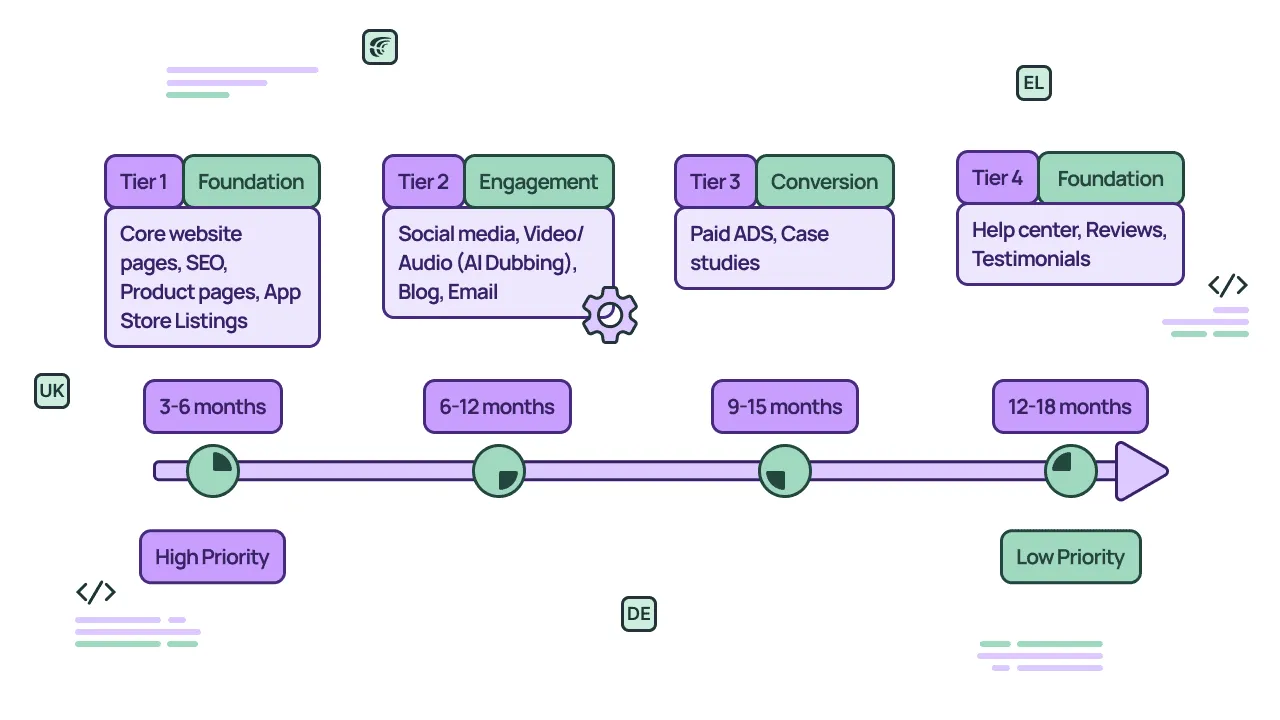
Focus on high-impact content first, and only after that start localizing other marketing channels. Below, we have prepared an example of content localization by tiers based on the business impact and time required to complete the process.
| Priority Tier | Content Type | Business Impact | Timeline |
|---|---|---|---|
| Tier 1: Foundation | Core website pages, SEO, Product pages, App Store Listings | Improved sales rates, organic visibility, app installs | 3-6 months |
| Tier 2: Engagement | Social media, Video/Audio (AI Dubbing), Blog, Email | Brand loyalty, viral reach, high social engagement | 6-12 months |
| Tier 3: Conversion | Paid ads, Case studies | Better campaign effectiveness, higher social engagement | 9-15 months |
| Tier 4: Trust | Help center, Reviews, Testimonials | Improved customer satisfaction and retention rates | 12-18 months |
Tier 1: Multilingual Website, SEO, and Product Pages
Your website should be at the center of all your localization and multilingual marketing. This is where customers can purchase the product and find the necessary details. Website = starting point for all activities.
Start with the web pages that can directly impact the purchasing process and customer decisions:
- Landing page
- Product or service pages
- Pricing information
- Key conversion pathways
Beyond translation, consider search engine optimization. Multilingual SEO is the basis of generating organic traffic in international markets. This process is more complex than translating the list of the currently implemented keywords. You need to:
- Understand local audience search behaviors
- Identify market-specific terms
- Optimize for search engines that may dominate in target markets
- Improve
Don’t forget the App Store. If you have a mobile app, your localization strategy must extend to the Apple App Store and Google Play Store. Localize your app title, keywords, descriptions, and visuals for each country. Users are much more likely to install an app that speaks their language in the preview. Learn more about App Store optimization and localization.
Tier 2: Multilingual SMM, Content Marketing & Email Marketing
Implementing multilingual marketing through social media channels is crucial for reaching global audiences. Aside from translation, there are the following vital considerations:
- Social media platform preferences
- Preferred content formats
- Communication styles within international markets
Localizing website blogs
Website blogs are an essential part of bringing organic traffic. Creating multilingual content requires implementing calendars that reflect local seasonal patterns, market interests, and celebrations. Successful multilingual blogs often feature local experts and contributors who provide authentic perspectives and insights about content creation. Check more on website localization.
Email marketing localization
Email marketing has also proven to benefit from localization efforts. Translating subject lines into native languages has shown a 25% open rate improvement. Email segmentation by language and local preferences helps create more targeted messages and improve customer engagement. Check our article on how to translate your email marketing.
AI Dubbing for video and sound localization
With tools like the Crowdin Dubbing Studio, you can localize your video and audio content using natural-sounding AI voices. The best feature is that all your text can be proofread by a linguist, so your dubbing sounds professional. Watch a quick demo:
Tier 3: Multilingual Paid Ads, Landing Pages, and Case Studies
High-quality paid ads can improve brand visibility and awareness among the global audience. Each ad should be localized based on the marketing research data:
- Ad copy adaptation
- Creative approach to capturing the audience’s attention
- Implementing targeting parameters for each target market.
Adapting ads helps reduce cost per click and make the ads highly relevant to locals.
Aligning landing pages with the ad campaigns is crucial. Especially when addressing market-specific goals and client motivations. To optimize the page and improve conversion rates, the teams should test the key value propositions, layouts, and calls-to-actions.
Case studies are important social proofs. And they need to be localized for different markets too. Some markets prefer number-based and technical specifications, while others value human experiences and peer recommendations.
Tier 4: Customer Support Content (Help Articles) and Reviews
Localizing customer support content has a direct impact on customer satisfaction and user experience. Self-service files include:
- Articles
- FAQ
- Troubleshooting guides
By providing help data in the native language, companies can decrease the number of customer support inquiries and improve the success rates of self-service.
By localizing customer reviews and expert testimonials, you can provide social proof for the global audience. Different markets rely on various reviews. When some clients prefer peer review, others opt for expert opinions or influencers’ recommendations.
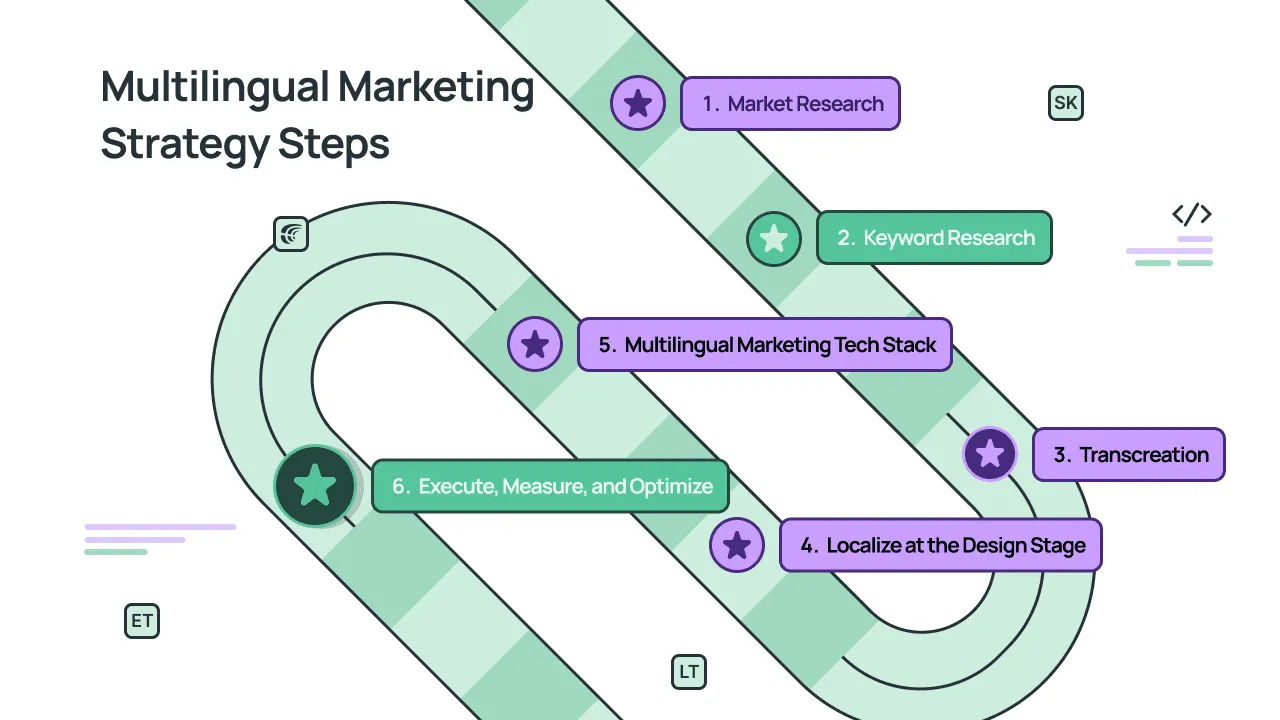
Building a Multilingual Marketing Strategy in 6 Steps
- Market Research
- Keyword Research
- Transcreation
- Localize at the Design Stage
- Multilingual Marketing Tech Stack
- Execute, Measure, and Optimize
Building a multilingual marketing strategy is a complex process that can also be confusing for inexperienced teams. We have prepared a step-by-step guide to help you establish effective processes and get the highest ROI.
Step 1: Market Research
Before moving to the next steps, your marketing team has to answer the three important questions:
- Which markets do we expand to? Either your top management made this decision, or you had to make your own research and choose the markets for expansion.
- Why these markets? Is there a product-market fit? Is the competition low? Is the purchasing power high?
- What is the goal? Are you trying to build brand awareness (top of funnel) or drive immediate sales (bottom of funnel)? Your goal will dictate whether you translate blog posts (awareness) or landing pages and ads (conversion).
To answer these questions, you need to do proper marketing research.
Once you have this understanding, you are ready to start the practical work.
Step 2: Keyword Research
Global SEO is the basis of creating a successful multilingual marketing strategy. Simply translating effective keywords from one language to another will have no impact if you are not sure if the local audience searches for this exact phrase.
Key actions within this step include:
- Local keyword research. Use common tools like Google Keyword Planner, Ahrefs, or SEMrush to identify the most effective keywords.
- Validate intent. Confirm that the abbreviations have the same meaning or can imply something slightly different.
Step 3: Adapt Your Messaging For Different Countries
Literal translation can lead to numerous errors due to the absence of context and nuance. This is why it is essential to implement transcreation. Transcreation is the process of adapting content into phrases that convey the same meaning, thereby increasing local impact while maintaining the brand image.
To see the power of transcreation, look at Red Bull. Translating their slogan “Red Bull gives you wings” literally into Chinese resulted in a phrase about growing feathers or limbs, in some Asian cultures, this means death.
Instead of a literal translation, the brand used transcreation to focus on the feeling of the product. They chose “Chāo yuè xiàng xiàng” (Beyond imagination), swapping the physical wings for the idea of limitless potential. While a direct translation would have confused the audience, transcreation successfully captured the brand’s energy.
Considering nuance is especially important for headlines, CTAs, slogans, and banners.
Step 4: Localize at the Design Stage
Do not wait until the launch. Building localization into your initial design allows you to grow gradually and launch in new countries much faster. It is about building a foundational design that works everywhere from day one.
For example, planning for specifics of different languages, like German text being longer or right-to-left layouts of Arabic, can save the company from extra development and testing work.
Best practices for design-stage localization:
- Implement adaptable design frameworks
- Consider potential text expansion (up to 30% for some languages)
- Support multibyte characters (Japanese, Korean)
- Preview translations in context by integrating Crowdin with Figma/Sketch
Try Crowdin design plugins:


Step 5: Build Your Multilingual Marketing Tech Stack
Implementing the right technological solution offers you numerous benefits through creating and implementing a multilingual marketing strategy. The wrong solution can not only cause more errors, but instead of helping your team, it can become a burden.
Why spreadsheets and emails fail at scale:
- Issues with version control and document changes
- No insights on translation progress
- No ability to track translation consistency across versions and projects
Role of a centralized localization platform
A Translation Management System (TMS) is the main localization platform for multilingual marketing management. Software like Crowdin offers the following features:
- Integrations with CMS, product design, customer support, and marketing tools.
- Ensures terminology consistency with the data from translation memory and glossary.
- Automated updates to synchronize all multilingual content (continuous localization).
- Managing human translations, AI localization, and creating complex workflows.
Try Crowdin now. No credit cards required.
Step 6: Measure and Optimize
Implementation of a multilingual marketing strategy does not mean the end of the process. For efficient optimization and continuous ROI growth, companies need to measure their KPIs.
- SEO: organic traffic growth in target languages.
- Ads: CTR and CPC improvements by language.
- Engagement: email open rates, blog dwell time.
- Conversion: localized vs. non-localized funnel completion rates.
- Customer success: support ticket deflection, CSAT scores.
Tools and Integrations for Multilingual Marketing
It is much easier to manage your multilingual marketing efforts if you have integrations with your TMS. All your content can be synchronized, translated, and managed inside one system.
Manual data management is the enemy of growth. Crowdin’s CMS integrations serve as a bridge between your source and translated content, turning this process into a fully automated pipeline.
Why Choose Crowdin for Managing Multilingual Marketing?

- 700+ apps and integrations. Connect directly to your marketing stack to sync content without manual copy-pasting.
- Design-stage localization. Use design plugins to preview how translated text fits into your layouts.
- AI & Machine Translation. Choose from 10+ AI providers (like GPT and Gemini) and various MT engines to generate instant drafts.
- Visual context. Provide screenshots and in-context editing so linguists can see exactly where their text appears.
- Brand consistency. Use a glossary, translation memory, and Vector Cloud, so all your translations across all platforms are consistent.
- Automated workflows. Set pipelines where new blog posts or emails are automatically sent for translation and pushed back to your CMS once finished.
- QA Checks. Built-in translation quality checks can automatically flag common errors like broken links, missing placeholders, or inconsistent formatting across languages.
Crowdin has even more features that can be helpful for marketing teams.
Build your custom localization roadmap.
So let’s explore more about the integrations with marketing tools and how they can simplify your work.
CMS Integrations for Translation
Crowdin does not just sync text, it understands the structure of your CMS. You can automatically sync and translate:
- Core Pages and Blog Posts: Articles, landing pages, and dynamic content blocks.
- Multilingual SEO: Meta titles, descriptions, and ALT tags are extracted automatically to ensure your site ranks globally.
- E-commerce assets: Product catalogs, categories, and tags (perfect for Shopify or BigCommerce).
- Custom fields: Support for advanced content structures.
Check out some of Crowdin’s integrations with popular CMS tools:




If you can’t find integration with your service, you can sumbit your request to Crowdin team.
Marketing Translation Automation Integrations
Explore Crowdin integrations with email services to help you manage translations and transcreation for all your email copies.


More marketing apps here
Help Desk Integrations
Customer support content localization can be effectively done through the integrations. You can auto sync content from your tools:


Conclusion
A multilingual marketing strategy is a key part of expanding your digital business internationally and implementing localization. The implementation process requires a structured process that will outline all the main steps to get the most satisfactory results.
An efficient multilingual marketing strategy allows companies to increase sales, lower CAC, widen the reach, and establish trust relationships with the global audience. Instead of being an outsider, show respect to the local culture and speak to them using the same language.
Provide a truly localized experience across all of your content
FAQ
What is multilingual marketing?
Multilingual marketing is a comprehensive marketing effort that involves creating market-specific content in multiple languages. It includes the adaptation of the brand’s messaging, visuals, and references to resonate with local audiences. The process goes beyond only translating content and focuses on implementing cultural localization and technical solutions across marketing channels.
How much does multilingual marketing increase sales?
The sales increase highly depends on the efficiency of the campaigns and products relative to the local markets. Most companies typically see 20-40% higher conversion rates on the localized versions compared to English-only ones. Some brands can deliver over 70% race by implementing profound multilingual experiences.
Which content should I translate first?
Do not try to do everything at once. To begin, focus on the fundamentals, including search engine optimization, website landing pages, and product pages. These types of content provide a faster ROI and establish a foundation for further localization of marketing channels.
What is the difference between translation and transcreation?
Translation is the process of converting words from one language to another. Transcription is the process of preserving the intended meaning of the translated content, including its emotional impact and cultural nuances.
How do I measure multilingual marketing ROI?
To measure multimarketing ROI, monitor the key metric and compare it to the baseline (English version performance) to accurately calculate the value. The key metrics include:
- customer conversion rates by language
- customer acquisition costs across the target markets
- organic traffic growth in target regions
- customer lifetime value for the multilingual segment
What tools do I need for multilingual marketing?
To structure the multilingual marketing processes, you essentially need a translation management system (TMS) as a core platform that integrates with:
- CMS
- marketing automation tools
- help desk software for the customer support team -and other marketing software
Such a compilation of tools will allow you to efficiently automate marketing workflow while maintaining quality and consistency across projects, channels, and languages.
How long does it take to see results from multilingual marketing?
The initial results of multilingual marketing implementation will be visible in 3-6 months. To fully integrate the multilingual marketing strategy takes more than 12-18 months. The process includes expanding localization efforts across all marketing channels and implementing continuous optimization based on the collected data.

Julia Herasymchuk
Julia Herasymchuk is the Content Manager with over 8 years of experience. She is a skilled professional at crafting compelling, well-researched content that resonates with audiences.